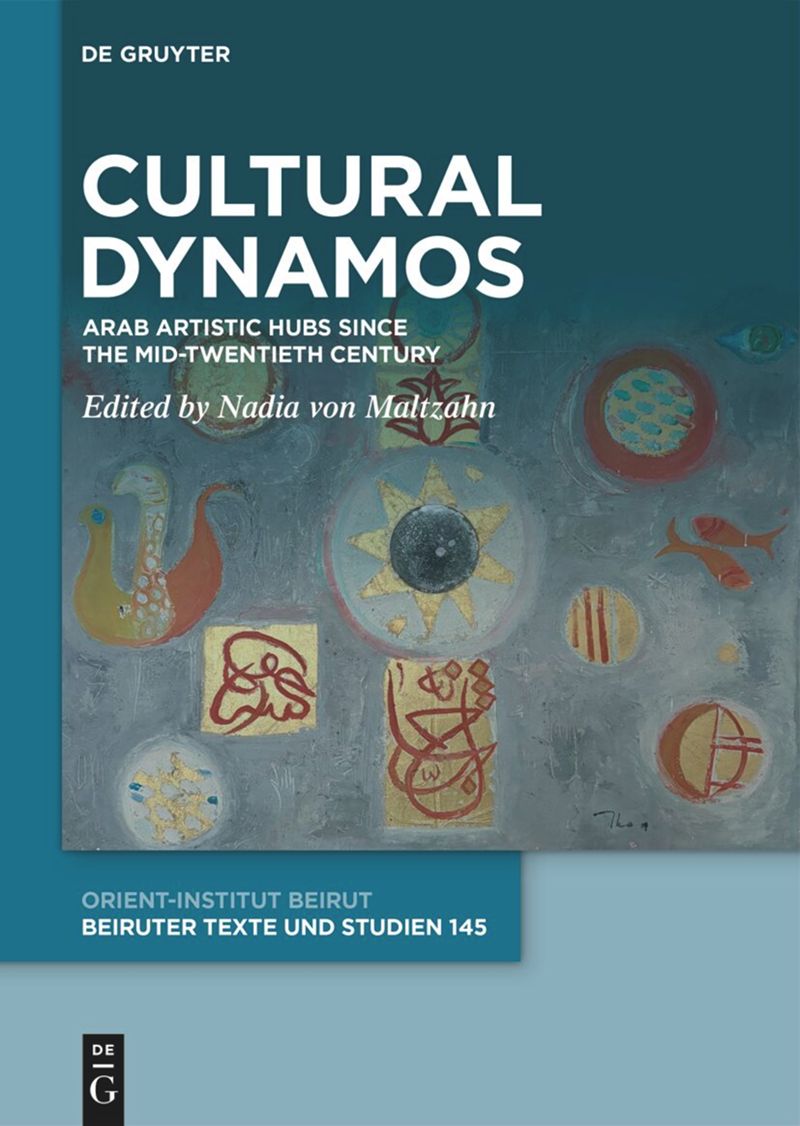
Cultural Dynamos. Arab Artistic Hubs Since the Mid-Twentieth Century
Cultural Dynamos. Arab Artistic Hubs Since the Mid-Twentieth Century, edited by Nadia von Maltzahn, has been published with contributions by Silvia Naef and Zouina Ait Slimani.
Manazir is pleased to announce the publication of Cultural Dynamos. Arab Artistic Hubs Since the Mid-Twentieth Century, edited by Nadia von Maltzahn.
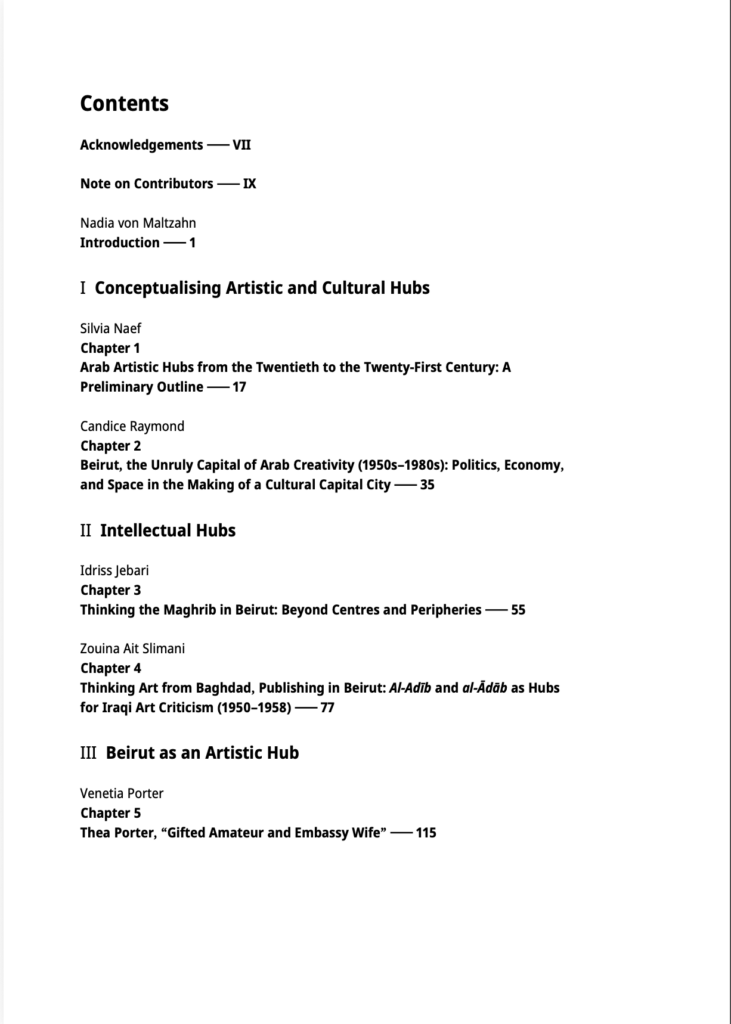
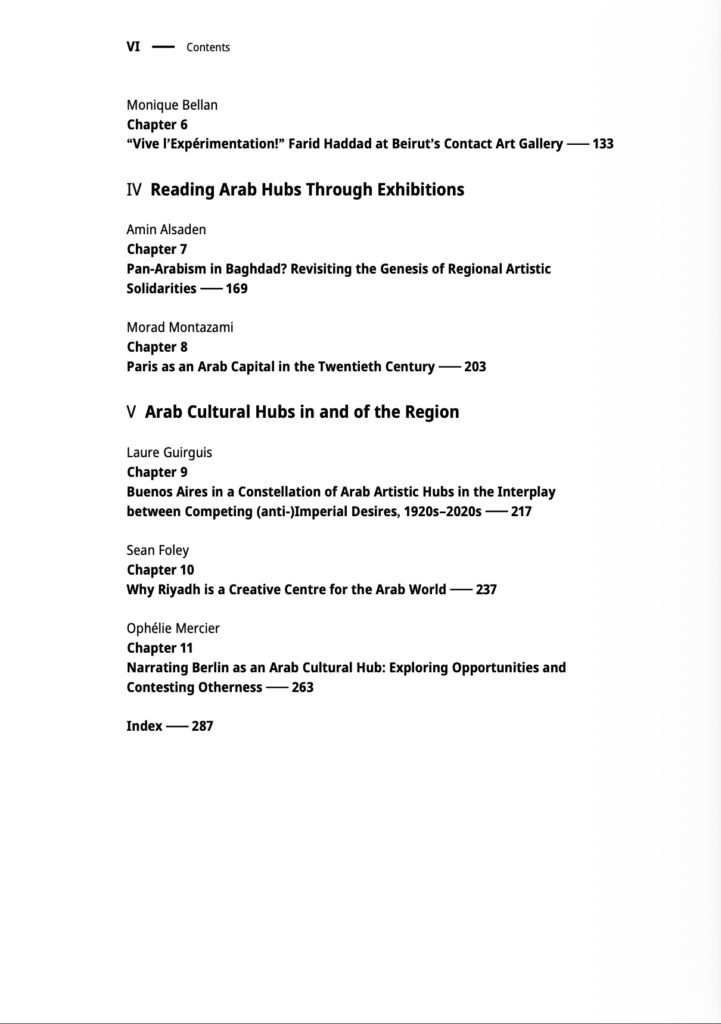
What makes a city a place of attraction for artists, critics, and intellectuals? How do cultural hubs emerge, evolve, and shift over time? Edited by Nadia von Maltzahn and published by De Gruyter Brill, this collective volume explores the formation and transformation of major artistic centres in the Arab world since the mid-twentieth century. Across eleven chapters, it examines the dynamics that have shaped these spaces of artistic production, intellectual exchange, and circulation of ideas. Beirut, Baghdad, and Riyadh are discussed alongside cities beyond the region, including Paris, Berlin, and Buenos Aires. Particular attention is given to the role of intellectual networks, galleries, exhibitions, and cultural institutions in facilitating artists’ mobility and shaping artistic scenes.
Two members of the Manazir network contribute to this publication. In Chapter 1, Silvia Naef, in “Arab Artistic Hubs from the Twentieth to the Twenty-First Century: A Preliminary Outline”, examines the historical and geographical evolution of artistic centres across the Arab world. She traces the shifting centre of gravity of the regional art scene, from the major cities of the Mashreq, shaped by the legacy of the Nahda in the twentieth century, to the Gulf in the twenty-first century, against a backdrop of changing regional power dynamics. Taking Paris and New York as two major international hubs as her starting point, she highlights circulation as a defining condition of any artistic hub. Such centres develop both through institutions, museums, and academies and through living conditions, social networks, and spaces of freedom that attract artists.
In Chapter 4, Zouina Ait Slimani, in “Thinking Art from Baghdad, Publishing in Beirut: Al-Adīb and al-Ādāb as Hubs for Iraqi Art Criticism (1950–1958)”, explores Beirut’s role in the circulation of Iraqi art criticism during the 1950s. As the Lebanese capital established itself as one of the region’s leading intellectual centres, the journals al-Adīb and _al-Ādāb_became important platforms for Iraqi art critics based in Baghdad. Through their writings, this chapter examines debates surrounding modernity, abstraction, and artistic engagement, while shedding light on the conceptions of modern Arab art developed by these authors. Publishing in Beirut enabled them to reflect on Iraqi art from a different geographical and intellectual setting, while remaining closely connected to the broader debates shaping Arab thought at the time.
The volume also features contributions by Candice Raymond, Idriss Jebari, Venetia Porter, Monique Bellan, Amin Alsaden, Morad Montazami, Laure Guirguis, Sean Foley, and Ophélie Mercier, alongside an introduction by Nadia von Maltzahn.
This publication offers an important contribution to the study of artistic and intellectual circulation in the Arab world, approaching cities not simply as sites of artistic production, but as interconnected spaces whose networks, institutions, and exchanges have helped shape the history of modern and contemporary art.
Nadia von Maltzahn (ed.), Cultural Dynamos. Arab Artistic Hubs Since the Mid-Twentieth Century, Berlin/Boston, De Gruyter Brill, 2026.